In the world of medium and high voltage power cables, the termination points where the cable ends and connects to equipment are zones of extreme electrical stress. Without proper management, this concentrated stress can lead to insulation breakdown, premature failure, and dangerous partial discharges. This is where Electrical Stress Control Self-adhesive Tape plays a pivotal, yet often unseen, role. It is a specialized engineering material designed to manipulate and tame the electric field, ensuring the long-term reliability of cable accessories.
The Problem: Why Stress Control is Non-Negotiable
When a cable's metallic shield or semiconductive layer is cut at the termination point, the smooth radial electric field inside the cable becomes radically distorted. The electric field lines concentrate intensely at the sharp edge of the cut shield, creating a region of extremely high electrical stress.
This is analogous to water flowing through a smooth pipe that suddenly hits a sharp, narrow constriction—the pressure at that point skyrockets. Similarly, uncontrolled electrical stress can:
Cause Partial Discharge (PD): Microscopic, repetitive electrical sparks that erode insulation over time.
Lead to Insulation Breakdown: Ultimately resulting in a complete failure of the termination.
Stress control materials are engineered to prevent this by redistributing the electric field.
The Material Science: A Blend of Ingenuity
This tape is far more than simple insulation. It is a composite material, typically composed of:
Base Polymer (e.g., EPDM, Silicone, or Butyl Rubber): Provides flexibility, environmental sealing, and a foundation.
High Dielectric Constant Fillers: The core of its function. These are dispersed particles (often metal oxides like titanium dioxide) that significantly increase the material's permittivity (εᵣ) or dielectric constant compared to standard insulation.
Conductive or Semiconductive Fillers (in some designs): Used in specific high-performance or nonlinear stress control tapes.
Self-adhesive Layer: Ensures a conformal, void-free bond to the cable components, which is critical for performance.
The Mechanism: How it Tames the Electric Field
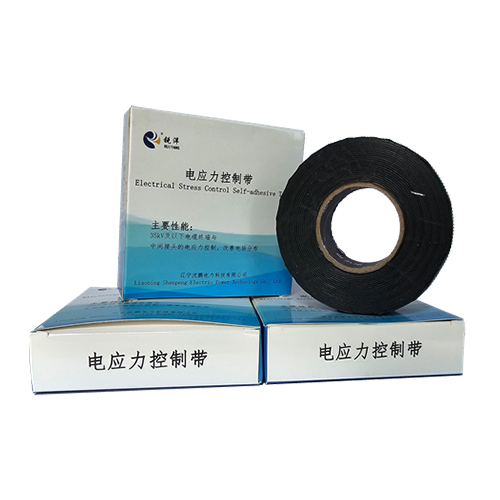
The tape works by being applied over the critical stress zone, forming a stress control cone or profile. Its primary mechanisms are:
Geometric Redistribution: By building up a tapered profile, it physically extends the distance over which the voltage drops, gently guiding and spreading out the electric field lines away from the sharp shield edge.
Capacitive Grading (Key Function): The high dielectric constant material acts like a series of many small capacitors between the conductor and ground. These "distributed capacitors" force the voltage to drop in a smooth, linear, and controlled manner along the length of the tape, eliminating sharp stress concentrations. It effectively "grades" the voltage.
Nonlinear Behavior (Advanced Type): Some tapes, known as Nonlinear Stress Control Tapes, have a resistivity that dramatically decreases as the electric field increases. Under normal operating voltage, they behave as an insulator. During a high voltage surge (like lightning), they become temporarily conductive, actively shunting the excess energy and providing superior protection.
The Critical Advantages of the Tape Format
Why use a tape instead of a pre-molded cone? The self-adhesive tape format offers unique benefits:
Universal Application: One tape can be tailored (by winding thickness and shape) to fit a wide range of cable diameters and voltage classes, reducing inventory.
Conformability: It molds perfectly to irregular surfaces, cable joints, and repaired areas, eliminating air gaps.
Repairability & Flexibility: It is ideal for field repairs, custom terminations, and complex geometries where pre-molded parts are not suitable.
Process Integration: It can be seamlessly integrated as a layer within a broader taping system that includes insulation and environmental sealing.
Electrical Stress Control Self-adhesive Tape is a fundamental component in modern cable accessory engineering. By combining smart material science with practical application benefits, it solves the critical problem of electrical field distortion. Its ability to reliably grade voltage stress and prevent insulation failure makes it an invisible but indispensable guardian, ensuring the safety and longevity of power networks in substations, industrial plants, and wind farms worldwide. Its proper selection and skilled application remain a cornerstone of high-voltage cable termination and splicing work.