



The Material Duel Between Silicone Rubber and EPDM for Cable Accessories
2026-01-28 15:38Cable accessories—joints, terminations, and connectors—act as the protective "skin and bones" for electrical connections. Their performance and longevity hinge on the polymer materials that form their core structure. In this critical role, two heavyweight champions dominate the field: Silicone Rubber and EPDM Rubber. Understanding their unique properties is key to selecting the right material for the job.
The Agile Performer: Silicone Rubber
Silicone rubber is often viewed as the high-performance "skin"—flexible, resilient, and exceptionally durable under extreme conditions.
Superior Hydrophobicity & Recovery: Its greatest strength is its water-repellent surface and the unique ability to recover hydrophobicity. If the surface gets contaminated or temporarily loses its water-shedding property, silicone molecules can migrate to restore it, providing long-term protection in wet environments.
Exceptional Thermal Stability: It performs consistently across a vast temperature range (approx. -50°C to +200°C), resisting hardening in cold and softening in heat.
Excellent Electrical Properties: It maintains strong dielectric strength and resistance to electrical tracking (surface arcing).
Trade-offs: It generally has lower mechanical tensile and tear strength compared to EPDM and tends to be more expensive.
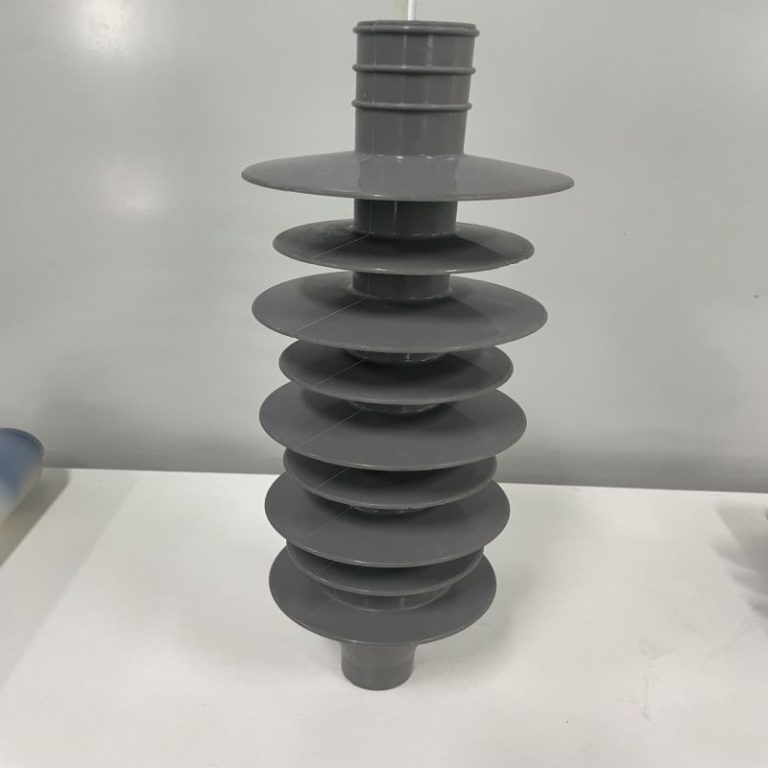
The Robust Workhorse: EPDM Rubber
EPDM is the dependable "bones"—mechanically tough, cost-effective, and offering excellent all-around environmental resistance.
Outstanding Mechanical Strength: EPDM boasts higher tensile strength, tear resistance, and abrasion resistance, making it physically tougher and more robust during handling and installation.
Superior Weathering & Ozone Resistance: It has excellent innate resistance to UV radiation, ozone, and general weathering, which is crucial for outdoor applications.
Good Electrical & Thermal Properties: It offers very good dielectric properties and operates reliably within a standard temperature range (approx. -40°C to +150°C).
Trade-offs: Its hydrophobicity is not self-recovering. Once the surface property is lost due to severe pollution or aging, it may not fully regain its water-shedding capability.
Head-to-Head: The Key Performance Comparison
| Property | Silicone Rubber (The "Skin") | EPDM Rubber (The "Bones") |
|---|---|---|
| Hydrophobicity | Excellent, with self-recovery | Good, but non-recovering |
| Mechanical Strength | Good | Excellent (Tougher) |
| Temperature Range | Excellent (Wider) | Very Good |
| UV/Ozone Resistance | Very Good | Excellent |
| Cost | Higher | More Cost-Effective |
| Typical Feel | Softer, more elastic | Firmer, denser |
Choosing the Champion: Application-Based Selection
The choice isn't about which material is universally better, but which is optimal for the specific environment and priority.
Choose Silicone Rubber for:
Highly Polluted or Coastal Areas: Where hydrophobicity recovery is critical.
Applications with Extreme Temperature Swings: Such as in deserts or next to equipment with high thermal cycling.
Compact Designs: Where its flexibility aids installation in tight spaces.
Choose EPDM Rubber for:
General Outdoor & Industrial Settings: With standard pollution levels.
High-Abrasion or Physically Demanding Environments: Where mechanical toughness is paramount.
Large-Volume or Budget-Conscious Projects: Where lifetime cost is a major factor.